1. The Backstory: The Compromises of Consumer Bluetooth Audio
Most modern home audio setups rely on portable Bluetooth speakers, but these devices are fundamentally engineered around compromises:
- Acoustic Compromises: Portable Bluetooth speakers prioritize compact, battery-friendly designs over acoustic physics. In an open living space or kitchen, their small single-point drivers produce narrow, compressed, and strictly directional sound. Without true stereo separation or dedicated low-frequency displacement, audio collapses into a thin, fatiguing profile as soon as you step away from the device.
- Sleep Latency & Connection Friction: To conserve battery power, portable speakers aggressively drop into sleep states. Playing a simple track turns into a multi-step chore: waking the hardware, waiting for loud chime prompts, navigating Bluetooth menus, and resolving connection conflicts when another paired phone or tablet holds the link hostage.
- Proprietary Ecosystem Lock-In: Mainstream "smart" speakers solve the battery sleep problem by staying connected to mains power, but they force users into closed ecosystems—demanding cloud accounts, subscription services, and vendor apps that ignore local high-resolution music vaults and open streaming protocols.
An audio setup shouldn't feel like a finicky peripheral that demands constant management. It should operate like an appliance—always on, immediately responsive, and acoustically uncompromising.
The Turning Point: Home Assistant & Music Assistant
The software foundation came together with Home Assistant and Music Assistant, creating a versatile, protocol-agnostic audio server:
- Direct access to local high-resolution music libraries and private network storage.
- Seamless aggregation of personal libraries, streaming services, and internet radio into a single unified interface.
- Synchronized streaming over open protocols, including Slimproto (Squeezelite), Apple AirPlay, and DLNA.
Music Assistant delivered the central brain, but it required an appliance-grade physical endpoint: a dedicated, permanently powered network audio player with instantaneous stream switching and genuine room-filling fidelity.
2. The Hardware Quest: Why 2.1 Bi-Amping?
To properly fill a room without bulky enclosures, standard full-range stereo speakers alone are insufficient. Small satellite speakers fit discreetly on shelves or countertops, but lack low-end authority. Forcing compact drivers to reproduce deep bass inevitably introduces intermodulation distortion and muddies vocal clarity.
The solution is a true 2.1 bi-amplified acoustic architecture:
- Amplifier #1 (Stereo 2.0 Mains): Powers left and right satellite channels dedicated purely to crisp highs and transparent midrange frequencies.
- Amplifier #2 (Subwoofer 0.1 PBTL Mono): Bridges both output channels into a single high-current Parallel Bridge Tied Load (PBTL) delivering dedicated, punchy low-frequency energy to a subwoofer hidden out of sight.
       [ Raspberry Pi 4B ]
       (Direct I2S 32-bit Audio Bus)
                │
        ┌───────┴───────┐
        ▼               ▼
 [ Amp #1: TAS5825M ] [ Amp #2: TAS5825M ]
   (Stereo 2.0 Mains)   (Subwoofer 0.1 PBTL)
        │                       │
 ┌──────┴──────┐                ▼
 ▼             ▼           [ Subwoofer ]
[Left]      [Right]       (Deep Bass <120Hz)
(Highs & Midrange)
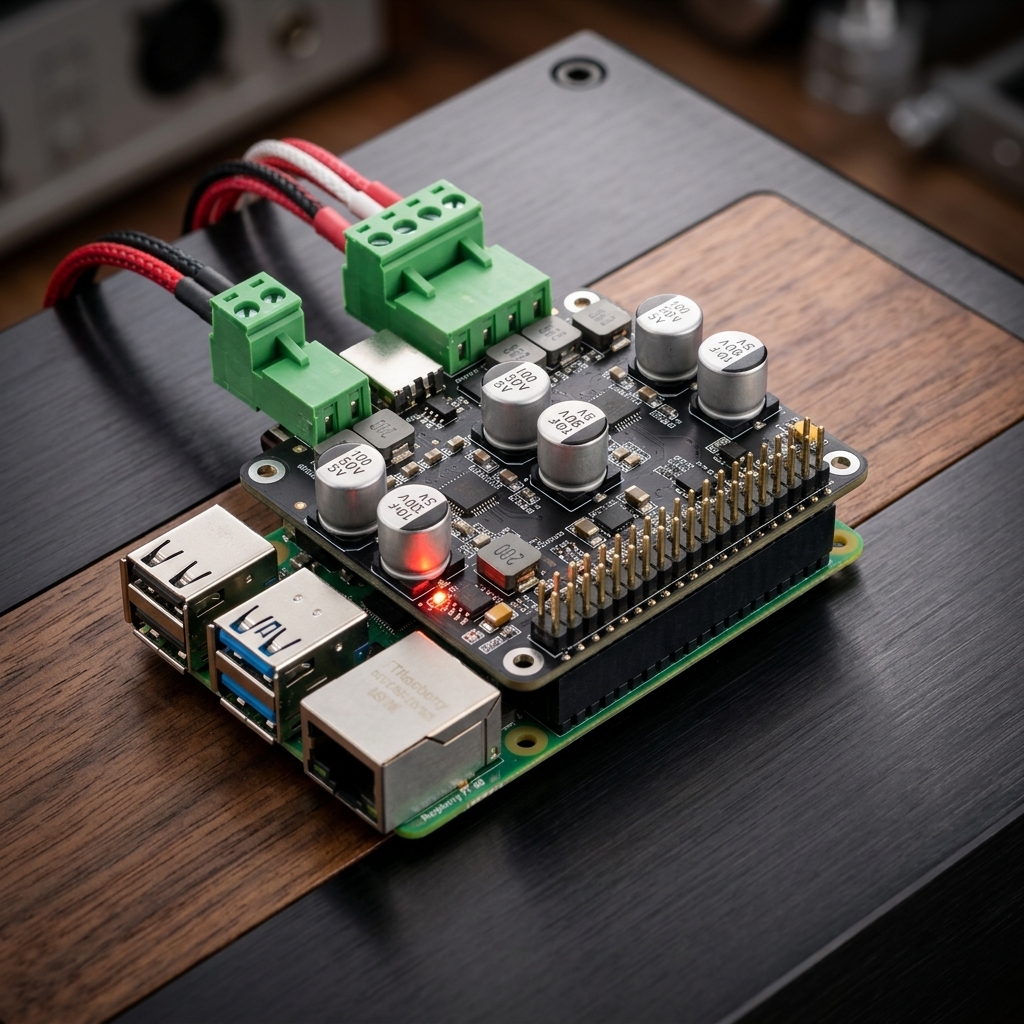
The hardware is built around a Raspberry Pi 4B paired with the Louder Raspberry Dual DAC / Amp carrier board, powered by dual Texas Instruments TAS5825M digital Class-D smart amplifiers.
From Test Rig to Invisible Kitchen Sound
To validate kernel driver integration, ALSA loopback routing, and hardware biquad DSP crossovers, we assembled a live countertop test rig featuring a dedicated subwoofer enclosure and satellite monitor speakers:
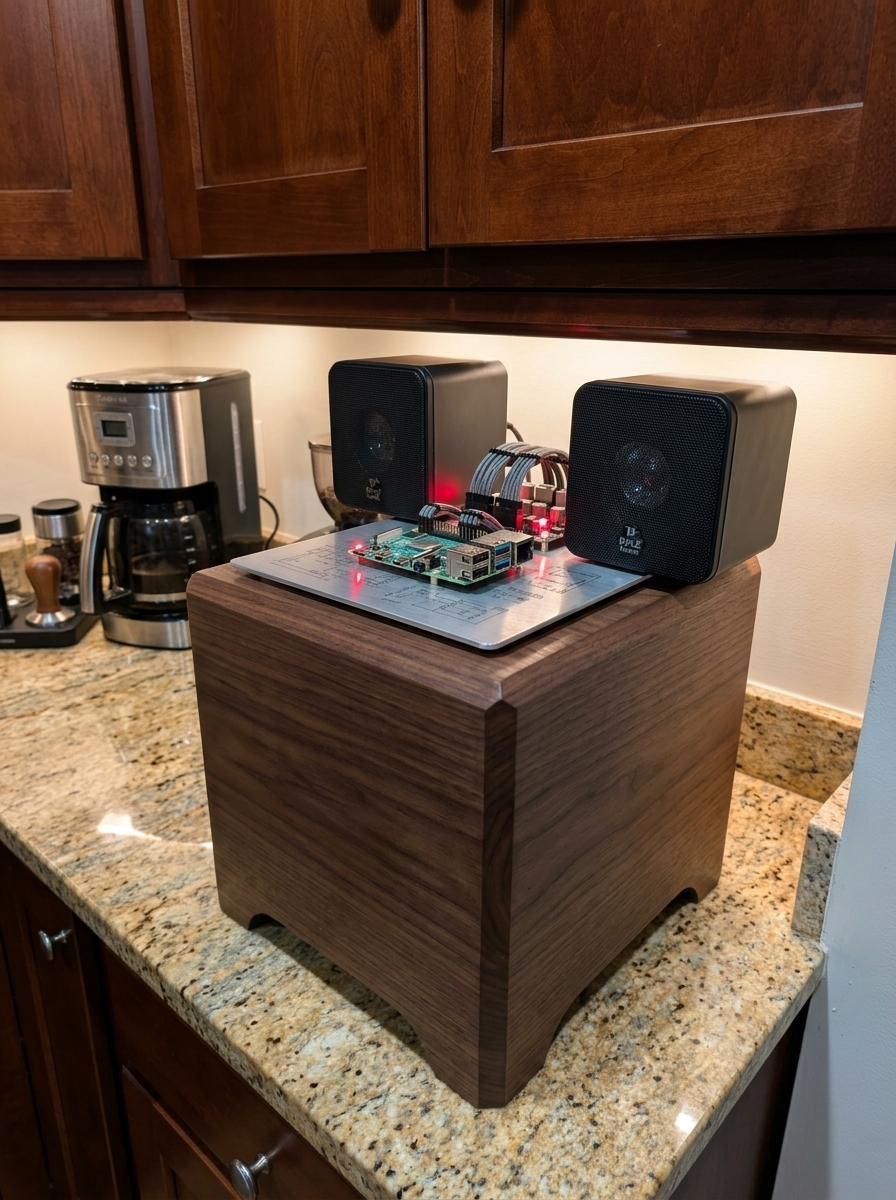
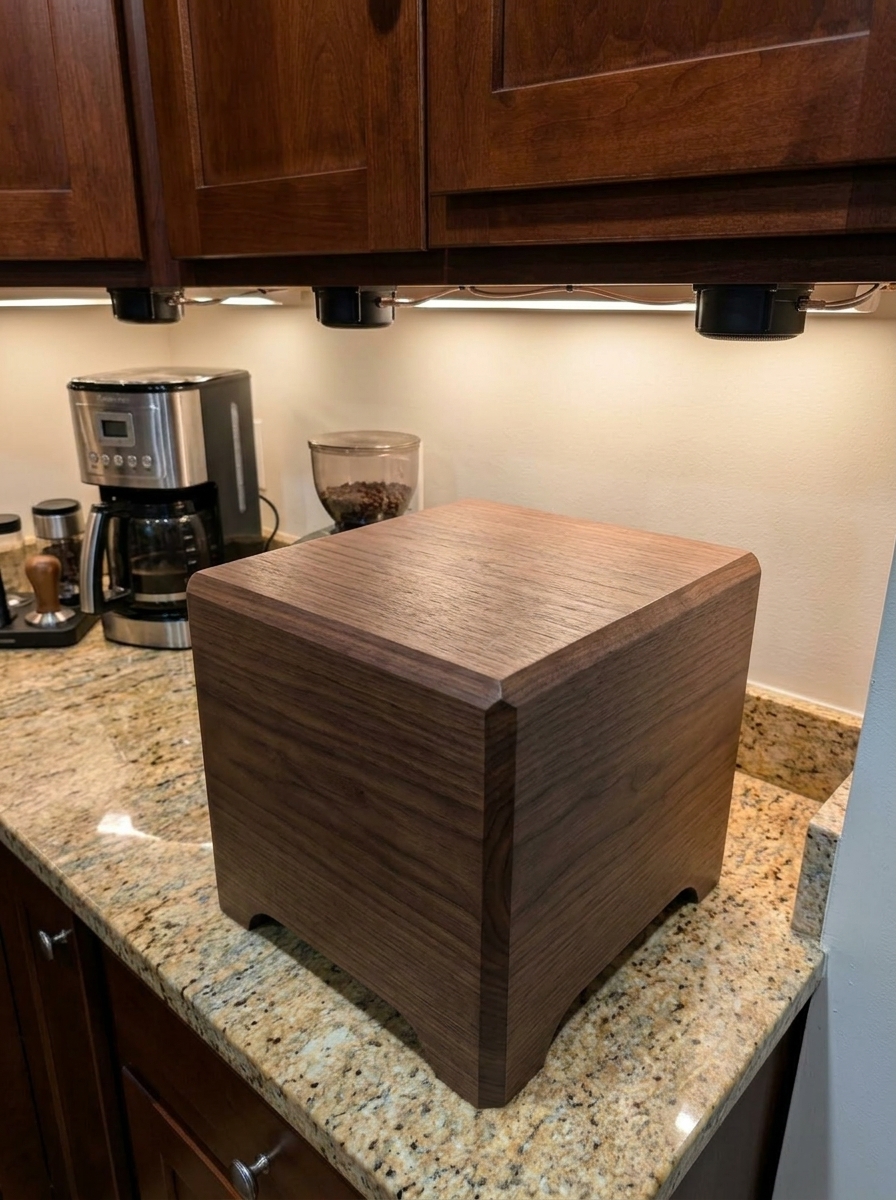
While the bench test rig used compact satellite speakers for driver calibration and crossover tuning, the permanent kitchen installation is engineered around an invisible soundstage: two pairs of Dayton Audio DAEX25 sound exciters (8Ω, 5W) installed discreetly on the underside of the upper kitchen cabinets, paired with the dedicated subwoofer.
Mounted flush to the under-cabinet woodwork alongside the under-cabinet lighting, the exciters transmit acoustic vibrations directly into the cabinetry structure, turning the panels into resonant soundboards with direct downward acoustic projection. Wiring two 8Ω DAEX25 exciters in parallel per stereo channel creates an ideal 4Ω nominal load for the TAS5825M Class-D amplifier, producing wholesome, natural, room-filling sound across the kitchen while keeping the granite countertops completely free of speaker enclosures:
Why Direct-Digital I2S?
Unlike conventional audio setups that route:
Digital Audio → DAC → Analog Cables → Amplifier
(which repeatedly amplifies analog noise and introduces ground loops):
- The Raspberry Pi outputs pure digital I2S audio directly from its SoC DMA controller over the GPIO header.
- The dual TI TAS5825M chips take that raw I2S digital stream directly into their internal digital signal processors (DSP). The signal stays completely digital all the way into the output switching stage.
- Result: Dead-silent noise floor, zero ground-loop hum, pristine 32-bit dynamic range, and surgical clarity.
3. The Software Vision: Universal Open Connectivity
Building a single-purpose Squeezelite player would have been straightforward, but a versatile living space demands flexibility.
The core architecture follows one rule: Support standard open protocols and reject proprietary lock-in.
No matter which device or platform initiates playback, streaming should be instantaneous and seamless:
- Music Assistant / Slimproto (Squeezelite): The primary daily driver. High-resolution, bit-perfect streaming from Home Assistant with instantaneous playback.
- Apple AirPlay (Shairport-Sync): Instant casting from iOS, iPadOS, and macOS devices with a single tap.
- Bluetooth 5.0 (BlueALSA / BlueZ): Direct wireless streaming from any phone, laptop, or display without requiring local network credentials.
- UPnP / DLNA (GMediaRender): Direct streaming from desktop media players like VLC, Audirvana, or BubbleUPnP.
graph TD
    subgraph Inputs ["Stream Inputs"]
        MA["🎵 Music Assistant (Slimproto)"]
        AP["🍎 Apple AirPlay (Shairport)"]
        BT["📱 Bluetooth 5.0 (BlueALSA)"]
        DLNA["📻 UPnP / DLNA (GMediaRender)"]
    end

    subgraph Core ["Core Engine"]
        HANDOVER["🔄 Bluetooth Idle Handover Engine"]
        ARB["⚙️ Vinu™ Dynamic Stream Arbiter"]
        DSP["🎛️ Hardware DSP Biquad Crossover"]
    end

    subgraph Hardware ["Linux Kernel & Hardware"]
        DTS["tas58xx-dual Device Tree Overlay"]
        I2S["Direct I2S Digital Bus (GPIO)"]
        DUAL["Dual TI TAS5825M Class-D Amps"]
        OUT["🔊 2.1 Acoustic Output"]
    end

    MA --> ARB
    AP --> ARB
    BT --> HANDOVER
    HANDOVER --> ARB
    DLNA --> ARB

    ARB --> DSP
    DSP --> DTS
    DTS --> I2S
    I2S --> DUAL
    DUAL --> OUT
4. Solving the Hard Engineering Challenges
Building this system required more than installing a few Linux packages. Combining these independent audio daemons into a unified, appliance-grade player required solving four core engineering challenges:
Challenge 1: Custom Linux Device Tree & Kernel DSP Controls
The Raspberry Pi kernel does not provide native support for dual TAS5825M amplifiers sharing an I2S clock line with independent I2C control addresses.
We developed a custom Device Tree Source overlay (tas58xx-dual-overlay.dts) and kernel driver (tas58xx.c):
- Mapped Amp #1 to I2C address
0x4c(configured in Stereo BTL mode). - Mapped Amp #2 to I2C address
0x4d(configured in Mono PBTL mode). - Exposed hardware DSP registers directly as native ALSA mixer controls:
'2.0 Digital'(Master stereo gain)'0.1 Digital'(Subwoofer trim level)'0.1 Crossover Frequency'(Hardware biquad low-pass filter: 100Hz, 120Hz, 140Hz, 150Hz)'DSP Profile'(Switching between Bookshelf monitors and flat-panel cabinet surface exciters)
Challenge 2: The Dynamic Stream Arbiter
Running Squeezelite, AirPlay, and Bluetooth daemons concurrently means multiple services compete for the same ALSA sound device. If an AirPlay session starts while Squeezelite is playing, the ALSA device blocks or produces distorted contention.
To resolve this, we engineered The Vinu™ Arbiter in Rust:
- Continuously polls ALSA PCM device states in
/proc/asound/at sub-second intervals. - When an active incoming stream is detected, the arbiter automatically suspends competing daemon listeners.
- When the active stream ends, a 5-second hysteresis grace period prevents abrupt toggling between tracks before restoring all listeners to active standby.
Challenge 3: Taming Bluetooth — The Idle Handover Algorithm
Consumer Bluetooth audio receivers often fail to accept incoming connections when a previously paired host device retains an idle link.
We implemented a dedicated Bluetooth Connection Arbiter:
- BlueALSA provides real-time transport states:
Running: true(active audio streaming) versusRunning: false(connected but idle). - When a new device requests a connection while another device is linked:
- If the existing link is idle, the arbiter automatically evicts it via
bluetoothctl disconnect. - The incoming connection is granted immediate, exclusive access to the audio pipeline.
- If the existing link is idle, the arbiter automatically evicts it via
- The web interface also provides an interactive "Connect / Switch" control for instant manual handover.
Challenge 4: Appliance-Grade Power Fault Tolerance
An embedded audio endpoint should operate like a durable home appliance rather than a fragile PC—it must tolerate abrupt power cuts without graceful shutdown commands.
- We configured an overlayfs read-only root filesystem.
- The Raspberry Pi can be abruptly powered off mid-playback thousands of times without corrupting the storage media. When power is restored, it boots directly into service in under 15 seconds.
5. The Control Center: Vinu™ Hi-Fi Web Dashboard in Rust
A dedicated network amplifier deserves an intuitive, responsive control interface. We built an interactive web dashboard in pure HTML5, CSS3, SVG, and Canvas:
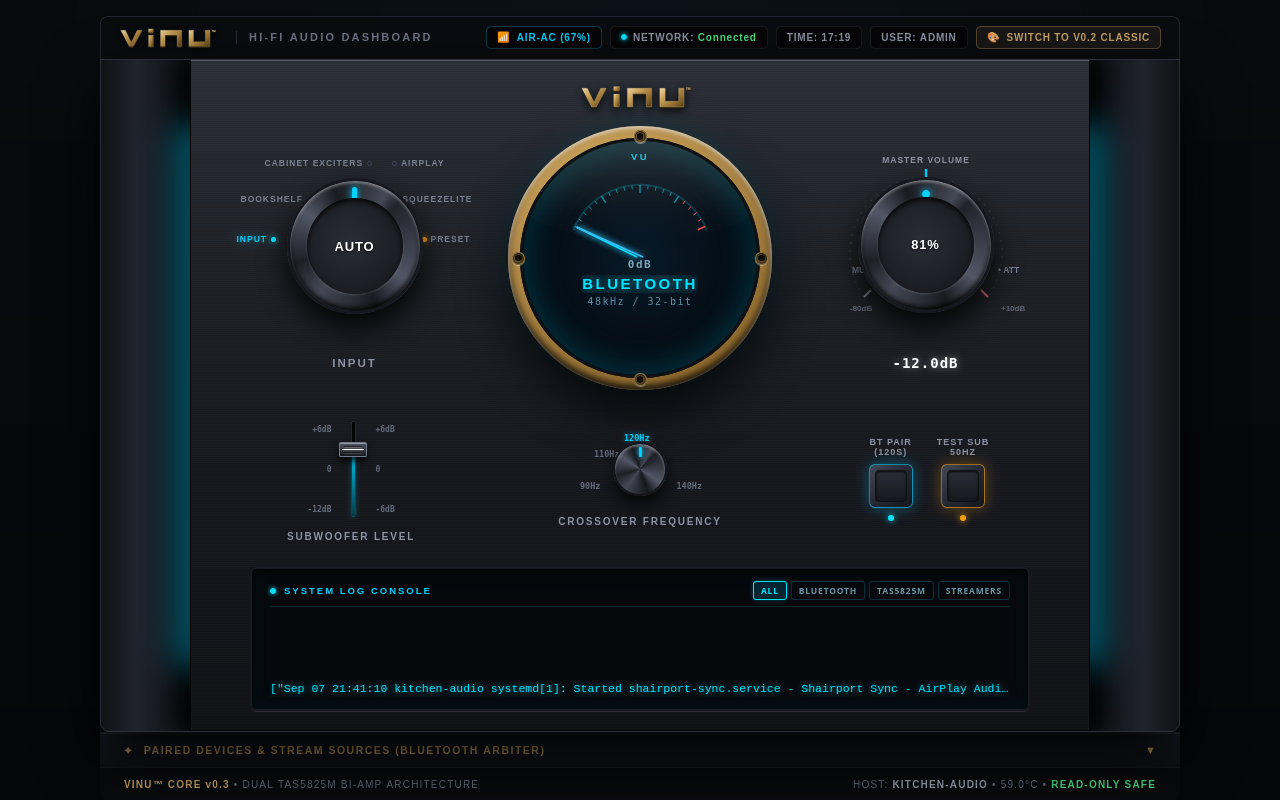
The entire frontend and API daemon are delivered as a single compiled static Rust binary using Axum, Tokio, and WebSockets:
- Circular Display & Real-Time Audio Visualizer:
- Features real-time analog dual VU meter needles calibrated in decibels and a 60fps audio waveform oscilloscope driven by an ALSA loopback audio capture thread streaming over WebSockets.
- Clickable to cycle between analog VU meters, dynamic oscilloscope waveforms, and live stream format bitrates (
48kHz / 32-bit).
- Input Selector & Master Volume Rotary Dials:
- Tactile rotary dials for input selection and master volume control, featuring illuminated status indicators for active stream sources.
- Subwoofer Level Precision Fader & Crossover:
- A calibrated vertical fader to fine-tune subwoofer output punch (-12 dB to +6 dB) alongside a stepped hardware crossover dial (
90Hzto140Hz).
- A calibrated vertical fader to fine-tune subwoofer output punch (-12 dB to +6 dB) alongside a stepped hardware crossover dial (
- Action Push Buttons & VFD Telemetry Console:
- Dedicated buttons for
BT PAIR (120s)pairing mode andTEST SUB 50Hzacoustic diagnostic tone with illuminated status indicators. - An integrated dark-glass Vacuum Fluorescent Display (VFD) rendering live receiver telemetry, active source protocol, stream format bitrates, and real-time playback metadata.
- Dedicated buttons for
6. How to Build Your Own (Weekend Project Blueprint)
If you want to build this setup for your own space, the complete software stack is organized into an automated deployment package:
# 1. Clone the repository
git clone https://github.com/yourusername/vinu-audio.git
cd vinu-audio

# 2. Run the automated installer (installs drivers, services, and web daemon)
sudo ./install.sh

# 3. Open your browser
http://kitchen-audio.local:8080/
Bill of Materials Quick Checklist
- Raspberry Pi 4B (1GB or 2GB)
- Louder Raspberry Dual TAS5825M Amplifier Board
- 24V / 6A DC Power Brick
- High-efficiency 24V-to-5V Step-Down Buck Converter (to power the Pi from the 24V bus)
- 4× Dayton Audio DAEX25 Sound Exciters (8Ω, 5W) mounted under the upper cabinets (wired in parallel pairs for 4Ω stereo load) + 4Ω Subwoofer
- High-endurance 16GB/32GB MicroSD Card
7. Reflections & What's Next
What began as a quest to eliminate the friction and acoustic limits of portable Bluetooth speakers resulted in an exceptionally capable dedicated audio system:
- Instant Gratification: Tap play via Music Assistant, AirPlay, or Bluetooth, and sound immediately fills the room.
- Acoustic Authority: The dedicated 2.1 bi-amp configuration delivers rich, punchy bass, pristine instrument separation, and zero distortion even at high listening levels.
- Zero Maintenance: It operates like a true consumer appliance — silent, rock-solid, and completely maintenance-free.
For the next installment of the Weekend Fun Projects series, I’m exploring adding an OLED physical front-panel display and a rotary encoder knob directly to the Pi's GPIOs.
Until then, queue up your favorite high-resolution tracks and enjoy the build!